Cooperation Protocol on the “National Internship Program” Signed for Law Faculty Students
A
Cooperation Protocol enabling law faculty students to carry out internships in
law offices, notaries, mediation offices, and centers within the scope of the
National Internship Program was signed on March 6, 2025, at Ankara Hakimevi.
The signing ceremony was jointly organized by the Ministry of Justice, the
Presidency of the Republic of Türkiye Human Resources Office, the Union of
Turkish Bar Associations, the Union of Turkish Notaries, and the Mediators and
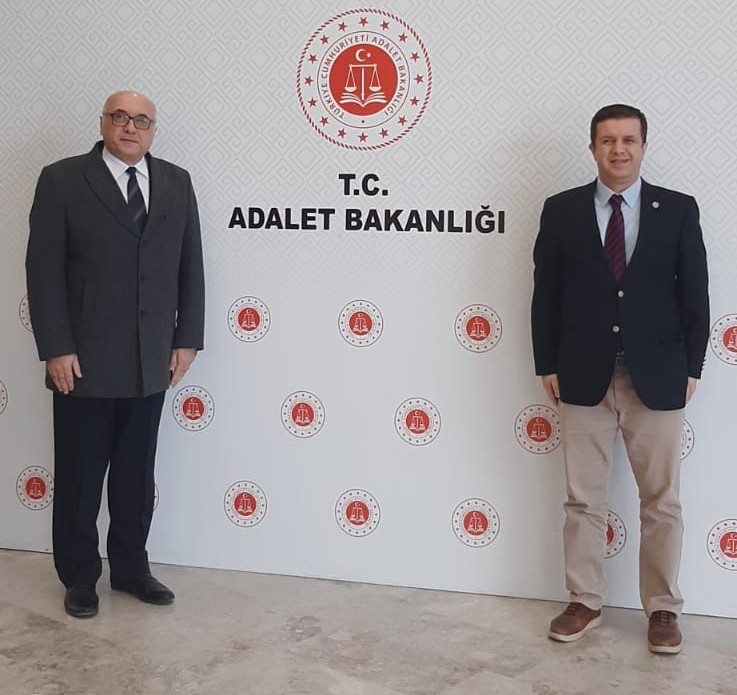
Mediation Centers Platform (TURAMEP). Balıkesir University was represented by
Vice Rector Prof. Dr. Murat Doğdubay and Acting Dean of the Faculty of Law,
Prof. Dr. Mustafa Yasan.
Presidency
of the Republic of Türkiye Human Resources Office, Assoc. Prof. Dr. Salim Atay,
stated: “With this protocol, internship opportunities for law students will
increase, and we will achieve better results.” Emphasizing that the cooperation
protocol under the National Internship Program would significantly expand
opportunities for future jurists, he noted: “Students who complete internships
start working three months earlier than those who do not. Turkey is among the
most successful countries in the world in implementing talent-based
development.”
Atay
further explained that the Ministry of Justice’s “Remote Education Platform”
currently has 183,058 registered users, with 99,051 active participants, and
that the ministry has uploaded 29 of its own training modules. He underlined
that the Ministry of Justice has conducted 6,318 live training sessions on the
platform, making it the most active institution in its use among all
ministries. He added that their broader focus remains on talent development,
with initiatives such as regional career fairs involving 17 ministries, various
institutions, private sector stakeholders, and local small-and-medium
enterprises. According to Atay, more than 1.25 million young people have
participated directly in these fairs, where the most popular activities
included virtual court practices, typewriting competitions, and other events
organized by judges and prosecutors. He noted that surveys and administrative
data consistently showed that these Ministry of Justice activities were the
most well-received by students.
Atay
highlighted that the National Internship Program is another crucial initiative
for talent development: “Specifically regarding law faculty students, 55% of
those who completed internships in the public sector did so at the Ministry of
Justice. The satisfaction rate among those who interned at the Ministry was
87%, which is an excellent figure.” He also emphasized that applications to the
National Internship Program are received annually from 613 departments
nationwide, with law students consistently ranking among the top applicants:
“This protocol will increase opportunities for law students and enable better
outcomes. Students who complete internships begin working earlier, and these
findings are based on administrative data, not just surveys. Investing in human
talent results in growth that is 2.9 times greater than investments in physical
capital. In justice-related innovations and reforms, this multiplier effect
rises to 4.7. Improvements in justice alone contribute as much to development
as investments in health, education, and R&D.”
President
of the Union of Turkish Notaries, Mr. Ahmet Alıcı, also addressed the
importance of the protocol, noting that notaries play a vital public role in
ensuring that rights arising from private law are effectively exercised and
safeguarded. He emphasized that notaries serve as preventive actors in the
resolution of disputes from the perspective of public order: “This protocol is
a concrete step in a strong cooperation aimed at investing in the future of our
young jurists. Through this project, we aim to contribute to the enrichment of
students’ knowledge and experience, which will also yield significant benefits
for our legal system. Internships will allow law students to become more
familiar with notaries and the notarial institution.”
President
of the Union of Turkish Bar Associations, Mr. Erinç Sağkan, stressed that
improving the quality of legal professionals is among the greatest services
that can be rendered to the country. He acknowledged that recent years had not
been entirely successful in this regard, but emphasized that identifying and
addressing these problems has been a priority. Thanking Minister of Justice
Yılmaz Tunç, Sağkan highlighted important reforms, such as the closure of
evening law programs and the restriction of transfers from justice vocational
schools to law faculties, as critical steps toward strengthening legal
education and the legal profession. He added: “The inclusion of these reforms
in the Judicial Reform Strategy Document, along with the subsequent increase in
the admission threshold for law faculties from the top 125,000 to the top
100,000, are significant measures. Raising the threshold further and
maintaining the effective implementation of the entrance exam for legal
professions are key steps to improving the quality of legal education.”
Expressing
his support for the protocol, Sağkan said: “There is no doubt that this
initiative will also enhance the quality of attorney internships. In the coming
years, law graduates will enter the system as attorney interns or judicial
trainees. Having prior experience through this pre-internship program will make
a significant contribution to the internships they will later undertake.” He
concluded by extending his gratitude to the Presidential Human Resources Office
and the Ministry of Justice and affirmed that the Union of Turkish Bar
Associations and local bar associations will fully support the implementation
of the protocol.
Chairman
of the Board of TURAMEP, Mr. Harun Uyanıkoğlu, stated that the program will
provide an important opportunity to introduce law students to the institution
of mediation, its objectives, and its philosophy. He underlined that interns
will gain firsthand knowledge of the operations of mediation centers and
acquire practical insights into alternative dispute resolution methods.
Following the speeches, Minister of Justice Yılmaz Tunç and the stakeholders formally signed the cooperation protocol.